
The Mist AP47

Updated: May 14
During the Mist Customer Advisory Board meeting in September I was able to touch an non-functioning Mist AP47 for the first time, above all else, I remember it being big, and loaded with promise. In December 2024 I was privileged enough to collaborate with the product team from Juniper/Mist. As our work together wrapped up, I found myself with a Pre-Production model for testing, and permission to share my thoughts with the General Public.
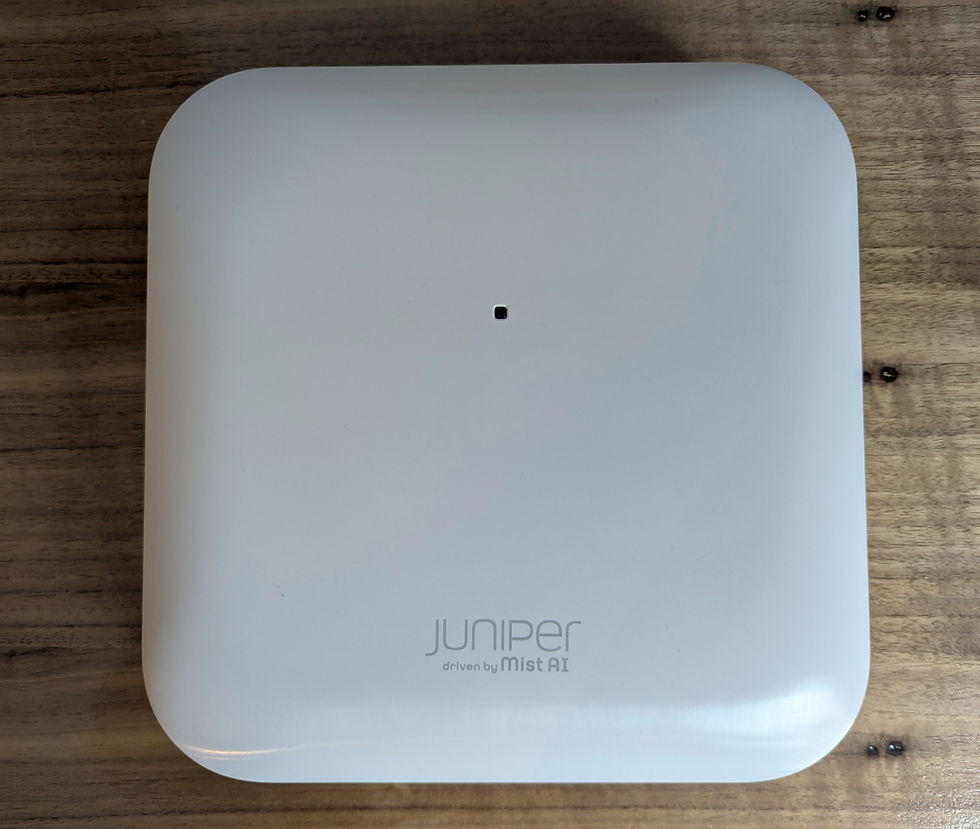
The Mist AP47 is one radio-packed Access Point. In the picture below I have samples moving from left to right are the Mist AP43I, Mist AP45I, and Mist AP47.

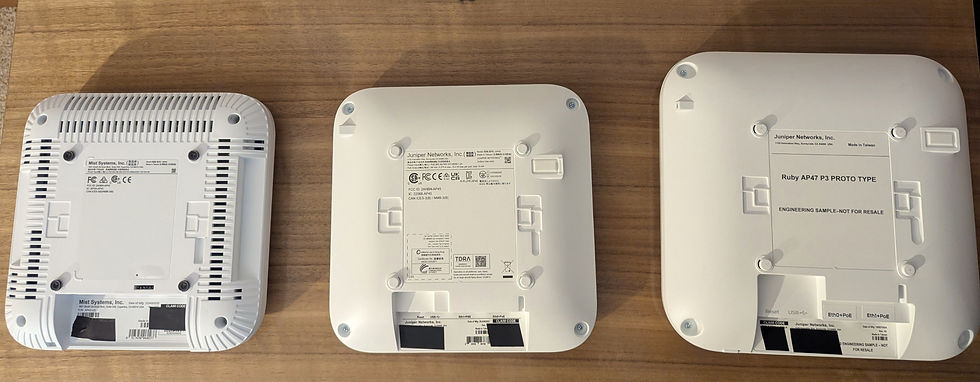
Weighing the models I have on hand the APs stacked up as follows:
AP43I 1404g
AP45I 1292g
AP47 1988g
The difference in weight may not be significant to you, but it can come in to play. The AP47 weighs a full pound and a half more than the previous model. This extra weight can really affect the daily work of a field engineer, and if you're out there performing APOS surveys on the regular, you may want to take a look at updating your gear before AP47 Survey Season starts.
The Vantage Point carbon fiber poles which support tall warehouses top out at 2kg for their tallest mast. We're right at the limit here, which makes me glad the AP47D does not require an external antenna. If your business is warehousing, distribution, or surveying you may need to look at your kit depending on your setup.
Taking a closer look at the back of the AP47 we can see one difference from the previous models- both RJ45 ports are labeled for POE.

The Ability to support POE-IN on both ports does not prevent you from placing a device downstream however and applying POE if that is your desire). The idea behind the dual POE inputs is the ability to combine 2x 802.3at feeds on a pair of links and combine the power inside the AP. In testing I have verified that the POE negotiation on both ports works, and the combination effort is seamless and works without requiring any sort of LAG configuration or trunking required on the switching side.

So why do we need all that POE? Radios, and lots of 'em!
Tri-Band radios with 4x4:4 operation
A dedicated Scanning Radio
Dual 802.15.4 Support for all your IoT needs and locationing
UWB support for improved precision locationing
After testing this AP in the field for some time now, I feel like I can talk a little more about it. Does it do 6GHz, absolutely! Does it perform well in 2.4GHz/5GHz, you betcha! What I personally like about this AP is that co-channel is reduced in my environment. Why do I like that?- Stuff roams better. In fact, Because you can get the AP47D model with the internal antennas, you can upgrade your environment to support 6GHz and apply a better, directional device to your floorplan without the huge cost of specialty antennas.
I'm not saying there isn't a use case for external antennas, there always will be, but the AP47D is a star. In fact- if I was an organization not ready to take the 6GHz plunge for some reason, but identified a need to replace an aging W-Fi 5/6 infrastructure, I would give these a look. The shape of the propagation provides clients the ability to make good roaming decisions and the 80MHz channels, Oh so good!
What really excites me about these though- UWB. I plan on digging deep into this technology. Oh, and Standard Power baby- did I mention Standard Power?


Comments